Can Singing Unite Us?
Matthew Swanson on bringing people together from three states and 92 zip codes through music

Matthew Swanson has spent the last several years working with one of the great American choral institutions: the Cincinnati May Festival, the oldest choral festival in the Western Hemisphere, founded in 1873 by a community that decided singing together was worth building an entire tradition around. After working with the May Festival in various capacities for many years, he took over as Director of Choruses in 2024, and now serves as Artistic Head of the organization, overseeing a number of choruses, for singers of all levels and ages, as well as conducting the organization’s flagship choir, the May Festival Chorus, the official chorus of the Cincinnati Symphony and Cincinnati Pops orchestras.
I sat down with him this past May, right in the middle of a week where he and I were on stage together performing Stravinsky and Orff — music that, on the surface, seems about as far from Bach as you can get, even though both composers clearly owe a great debt to Bach, like most Western classical composers.
The May Festival Chorus draws its singers from three different states and 92 different zip codes — a genuinely wide cross-section of a region that is deeply politically purple, not red or blue. Rather than treating that diversity of belief as something to work around, Matthew talked about it as part of the point: a room full of people who likely disagree with each other on a variety of political and religious touchpoints, choosing every Tuesday night to arrive at the same time, the same pitch, the same vowel, in pursuit of something beautiful that none of them could make alone.
It’s a small, weekly act of common purpose in an era where that kind of communal activity seems to be getting harder to find — and it illuminates another layer to our central question: is Bach’s music, or any music this demanding, actually for everyone?
My conversation with Matthew was not just timely because of our Stravinsky and Orff collaboration this past May — we are getting ready to work together again in March 2027, when we join the Cincinnati Symphony Orchestra and their music director Cristian Măcelaru for a performance of Bach’s St. Matthew Passion, in which I am going to sing both the roles of the Evangelist and the tenor arias. That collaboration was also very much on my mind walking into this one, so it was fascinating to discover how pivotal that piece was in Matthew’s musical life as part of this discussion.
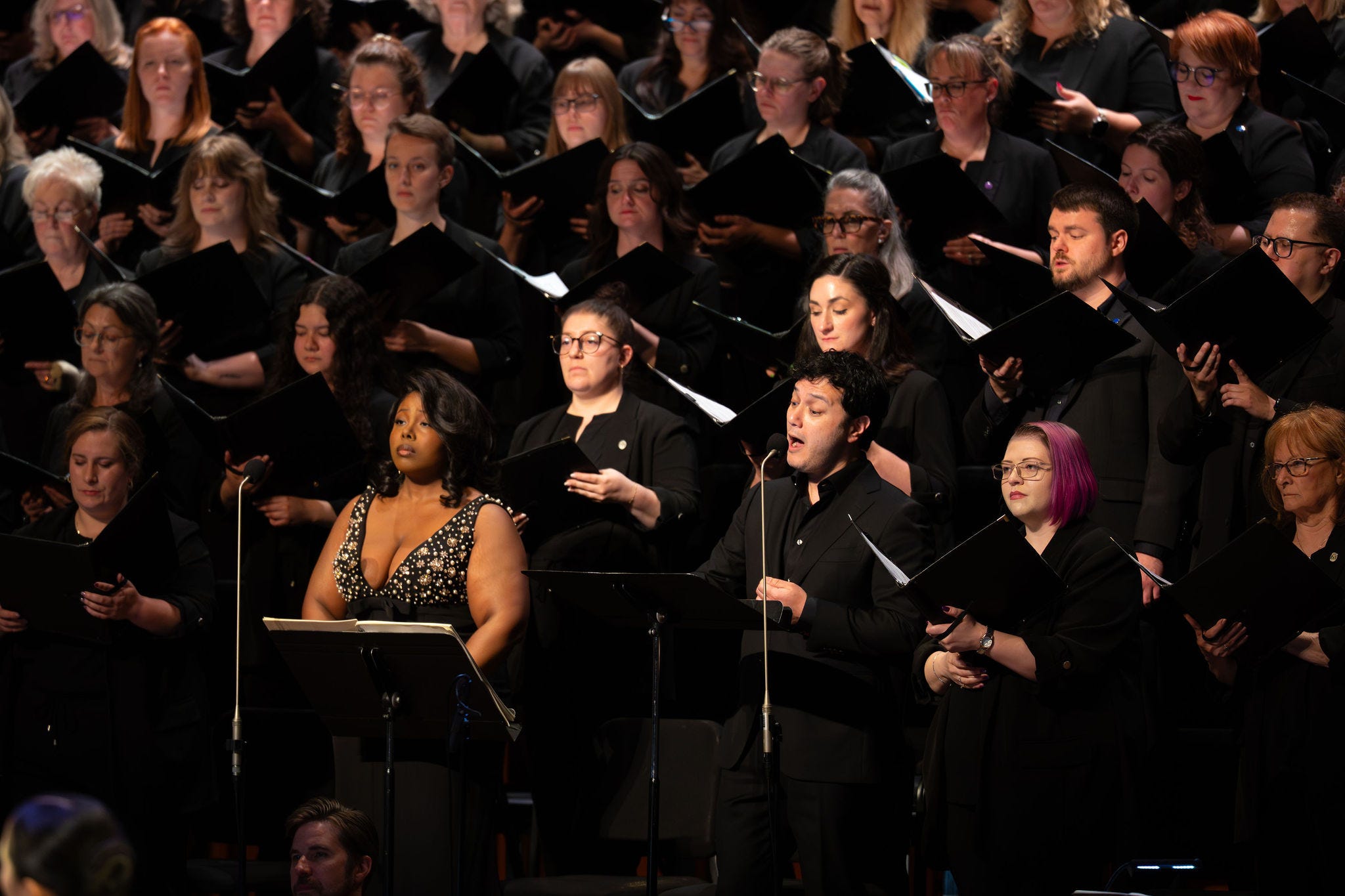
performing Orff’s Catulli Carmina with the May Festival Chorus in May 2026
Toward the end of our conversation, I was struck by Matthew’s comments about time: about his hope that he has enough time to continue to find deeper fluency or mastery with some of Bach’s most challenging works, and what it means to spend our time — the most expensive thing we have, as Matthew so insightfully points out — in pursuit of music this demanding.
The finite nature of our most precious resource, the time we have on this earth, is confronted directly in the aria we chose to close this episode.
It comes from Cantata BWV 8, Liebster Gott, wenn werd ich sterben (Dearest God, when will I die), and the tenor aria asks something even more pointed: why should the spirit recoil when its final hour strikes? Bach sets it over a steady, tolling accompaniment, like a clock — or a bell — that never quite stops. It’s not a morbid piece. It’s the opposite: it’s an act of acceptance and a reassurance that we can face the end of this life without terror. Why resist the unchangeable fact that our own clocks will run out? What’s more important is what we do with the time we have, and Matthew’s work with the Cincinnati May Festival posits that perhaps the most valuable use of that time is to invest it in our community, creating communal works of beauty with our friends and neighbors.